G20 Amerika Serikat: Indonesia Suarakan Hak Berdaulat Transisi Energi dan Keunggulan B50
Global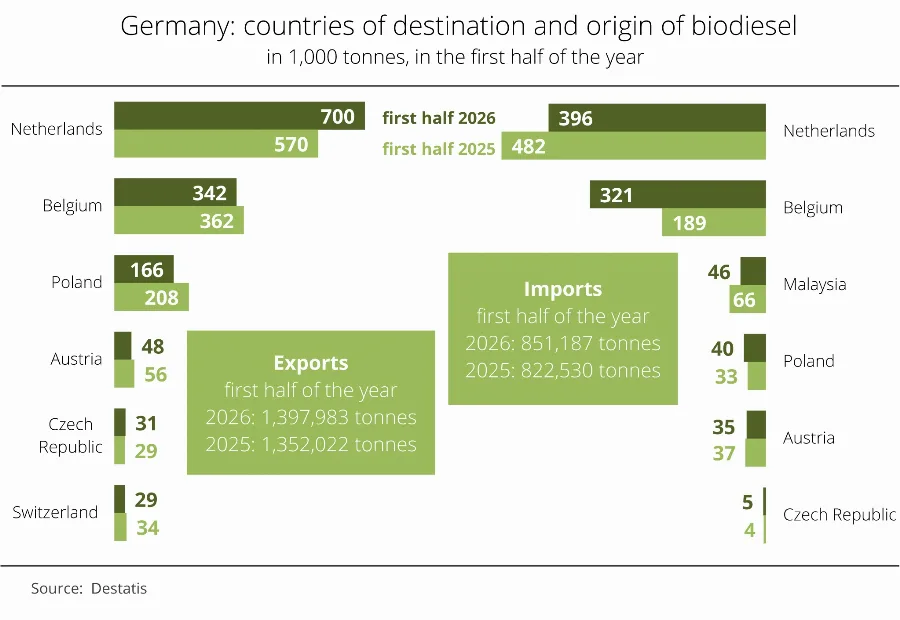
German Biodiesel Trade Rises in First Half of 2026
German foreign trade in biodiesel has picked up pace in 2026, with both exports and imports gaining momentum. The Netherlands, with its Rotterdam and Amsterdam ports, remains the central hub.
According to data from the German Federal Statistical Office, foreign trade in biodiesel has increased in 2026. In the first half of 2026, biodiesel exports grew just over 3.4 per cent compared with the same period of the previous year, rising to 1.4 million tonnes. Similar growth was recorded in imports, with Germany purchasing 851,200 tonnes of biodiesel from abroad, approximately 3.5 per cent more than a year earlier.
The Netherlands remains Germany's primary trading partner, serving as a hub for overseas imports via ports such as Rotterdam and Amsterdam. According to analysis conducted by Agrarmarkt Informations-Gesellschaft (mbH), major deliveries also came from Malaysia and Belgium. Whereas Malaysia's shipments to the EU market fell 30.2 per cent, those from Belgium rose approximately 69.6 per cent.
EU Member States continue to be the main recipients of German biodiesel exports, particularly the Netherlands, Belgium, Poland, and Austria. While the Netherlands increased its imports 22.8 per cent year-on-year, Polish imports declined approximately 20.3 per cent.
Biodiesel exports to neighbouring EU countries stabilize prices for rapeseed oil and, consequently, producer prices for rapeseed. The Union zur Förderung von Oel- und Proteinpflanzen e. V. (UFOP) has emphasised this effect, referring to current reports on this year's rapeseed harvest. The high rapeseed prices have partly offset the regionally disappointing harvest. UFOP has forecast prices at this level for the coming season, as EU Member States are required to implement the revised Renewable Energy Directive (RED III) in 2026 and 2027, which provides for higher biofuel mandates. The association holds that the rise in HVO imports to at least 325,000 tonnes in the first half of the year confirms just how strong demand for rapeseed is as a consequence of biofuel demand. These figures are not included in the Destatis statistics.
UFOP has pointed out that the US, Canada and Brazil shape their national biofuels policies as active instruments for supporting agricultural prices and incomes.
(Source: UFOP)