Kawal Implementasi B50, Pemerintah Perkuat Sinergi dengan Sektor Otomotif
Kolom
Outlook on the Financial Burden of the B50 Biodiesel Program
A discussion of the outlook for the B50 biodiesel program’s financial burden is crucial in the context of the sustainability of Indonesia’s mandatory biodiesel policy. One of the key indicators of this sustainability is the ability of the Plantation Fund Management Agency to cover the price difference between biodiesel and diesel fuel.
This price difference reflects the amount of subsidies or incentives that must be provided to keep biodiesel competitive in the domestic market. Therefore, an analysis of the potential financial burden on BPDP, particularly for a specific quarterly period such as Q3 2026, is crucial for assessing whether the palm oil fund still has sufficient capacity to support the sustainable implementation of the B50 program.
The outlook for the B50 biodiesel program’s financial burden in Q3 2026 must be assessed by comparing the Biodiesel Market Price Index (Harga Indeks Pasar, Biodiesel HIP) and the Diesel Market Price Index (Harga Indeks Pasar, Diesel HIP). Under the mandatory biodiesel scheme, the difference between the Biodiesel HIP and the Diesel HIP serves as the basis for calculating the price gap payments covered by the Palm Oil Fund. The larger the difference between the Biodiesel HIP and the Diesel HIP, the greater the funding requirement that must be provided. Conversely, if the Diesel HIP increases and approaches or even exceeds the Biodiesel HIP, the required gap payment decreases.
Methodologically, the HIP for Biodiesel is calculated using the biofuel market price index formula: the average KPBN CPO price plus a conversion cost of USD 85 per MT, then multiplied by a conversion factor of 0.87 kg of CPO per liter. Meanwhile, the HIP for Diesel is calculated based on the published MOPS or Argus prices for 0.25% sulfur gas oil, which in this projection is modeled using Brent crude oil prices as the primary driver.
Thus, the projected cost of B50 in Q3 2026 is influenced not only by the price of CPO as a biodiesel feedstock but also by the dynamics of fossil fuel prices, particularly crude oil and gas oil.
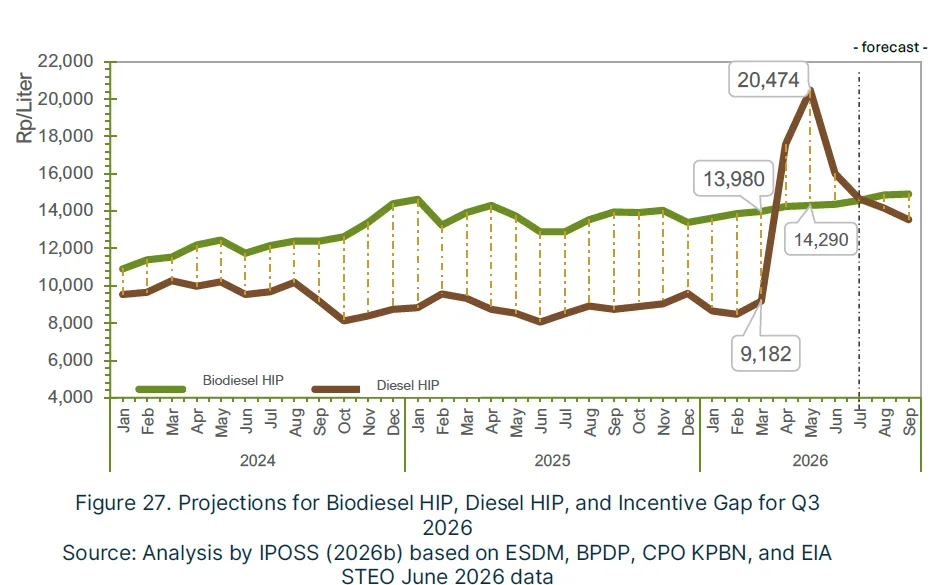
Based on the projections, the difference between the HIP for biodiesel and the HIP for diesel in Q3 2026 narrowed quite sharply compared to normal conditions. In July 2026, the HIP for diesel is projected to be Rp14,657/liter, slightly higher than the HIP for biodiesel at Rp14,563/liter. Consequently, the difference becomes negative at approximately Rp94/liter, meaning the incentive requirement for that month is zero. This situation indicates that when fossil diesel prices rise significantly, biodiesel no longer requires a price gap payment for that month.
Entering August and September 2026, the HIP for diesel begins to decline in line with the projected flattening of Brent prices. In August 2026, the HIP for diesel is projected at Rp14,140/liter, while the HIP for biodiesel is projected at Rp14,865/liter, resulting in a positive incentive gap of Rp725/liter. In September 2026, the HIP for Diesel is expected to decline further to Rp13,528/liter, while the HIP for Biodiesel is projected to rise to Rp14,907/liter, causing the incentive gap to widen to Rp1,379/liter.
Assuming that the volume of government-subsidized biodiesel in Q3 2026 is 4.9 million kL, the funding requirement to cover the price difference can be calculated by multiplying the biodiesel volume by the incentive amount per liter. If this volume is distributed evenly over three months, the monthly funding volume is approximately 1.63 million kL, or the equivalent of 1.63 billion liters.
Based on this assumption, the price gap payment requirement for July 2026 is estimated to be zero, since the HIP for diesel is higher than the HIP for biodiesel. In August 2026, with an incentive of Rp725 per liter, the funding requirement is estimated to be approximately Rp1.18 trillion. In September 2026, with an incentive of Rp1,379 per liter, the financing requirement increases to approximately Rp2.25 trillion. Thus, the total financing requirement for the biodiesel price gap in Q3 2026 is estimated at approximately Rp3.44 trillion.
This simulation shows that the financial burden of the B50 program in Q3 2026 is relatively more manageable compared to a scenario where the spread between the HIP for biodiesel and the HIP for diesel is at a wider, normal level. The rise in crude oil prices and the HIP for diesel in the first half of 2026 caused the price spread between biodiesel and diesel to narrow. In fact, by July 2026, the need for incentives drops to zero because the HIP for diesel is slightly above the HIP for biodiesel. Consequently, the pressure on the palm oil fund during the initial implementation of B50 is alleviated in terms of covering the price gap.
However, this situation does not mean that the financing risks associated with B50 have disappeared. When crude oil prices begin to fall, the HIP for diesel will also decline more rapidly than the HIP for biodiesel. This is evident in August and September 2026, when the incentive gap turns positive again and financing needs begin to rise. Consequently, the sustainability of B50 financing remains highly sensitive to changes in crude oil prices, exchange rates, CPO prices, and the applicable HIP formula.
From a strategic perspective, Q3 2026 presents an unusual combination. On one hand, the CPO Reference Price, Export Levy, and Export Duty increased due to tightening palm oil supply. On the other hand, the biodiesel incentive burden was relatively lower because the HIP for Diesel also rose due to global energy price pressures. These conditions provide better fiscal space for managing palm oil funds in Q3 2026, but caution is still warranted because a decline in oil prices could once again widen the HIP gap between biodiesel and diesel in the subsequent period.
Overall, the outlook for the B50 program’s financial burden in Q3 2026 indicates that funding requirements are determined not only by the volume of biodiesel distributed but also by the dynamics of the price gap between biodiesel and diesel. With a funding volume of approximately 4.9 million kL, every Rp100/liter change in the HIP gap can alter funding requirements by approximately Rp490 billion for a single quarter. Therefore, the management of the B50 program must simultaneously monitor developments in CPO prices, crude oil prices, the rupiah exchange rate, biodiesel volume, and the availability of palm oil funds derived from the Export Levy.
(Source: Indonesia Palm Oil Strategic Studies, Indonesia Palm Oil Industry OutlookQ3 2026)